Wilson Inlet Catchment Committee
  • Home
  • Get Involved
    • Upcoming Events >
      • The Ripple Effect EOI
      • Soil Testing EOI 2025
      • Dung Beetle Soil Health Initiative EOI/survey
    • Volunteer EOI
    • Membership >
      • WICC Membership Form
      • OKGG Membership Sign-Up
    • Funding Opportunities >
      • Soil Testing
      • Fencing and Revegetation
    • Feral Management
    • Report A Pig
  • About
    • Projects >
      • Current Projects >
        • Soils - New Horizons
        • Climate Smart Agriculture
        • Dung Beetle Soil Health Initiative
        • Wilson Inlet Management Strategy
        • Community for Cockies
        • Cockies for Cockies >
          • Plants Used by Carnaby's Black Cockatoo
        • Saving Boordenitj – Salvaging Bittern Habitat in Southwest WA
        • Healthy Estuaries WA
        • Wilson Inlet Winter Active Dung Beetles: Phase 2
        • Eungedup
      • Previous Projects >
        • Ferals
        • Waste to Net Zero (Biochar Program)
        • OKGG Owingup/Kent Grower Group
        • Soilwise
        • WIGG the Wilson Inlet Grower Group
        • UPtake
    • Our Plans >
      • Lindesay Link Conservation Action Plan
      • WICC Proteacea Vegetation Survey 2016
      • WICC Strategic Plan and Constitution
      • Wilson Inlet Management Strategy
    • Meet the Team!
    • Our Catchment
    • Contact Us
  • WICC News
  • Support Us
    • Kwoorabup Community Nursery >
      • Nursery Volunteer Register
    • Donate
  • Eungedup
    • Eungedup Access Checkout
    • Why Eungedup Wetlands needs to be preserved!
    • How Your Donation will be Use
    • How Eungedup Wetlands will be Managed
    • Our Donors
  • Learning Centre
    • Sustainable Agriculture >
      • Dung Beetle Farm Management Guide
      • Cartoon Collection - Earls Adventures >
        • Managing Water in a Drying Climate
        • Feral Management OKGG
        • Arum Lilies
      • Collection of Dougie the dung beetle cartoons >
        • Rotational Grazing
        • Stock Health
        • Pasture Diversity
        • Soil Chemistry/Nutrient Efficiency
        • Soil Carbon
        • Soil Biology
      • Interviews with local farmers
    • Biodiversity >
      • Interview with Marino Bocuzzi
      • The Abby Carnaby Chronicles
      • Weeds
      • Feral Management
      • Seagrass Report
      • Flora Surveys
      • Interview with Elders >
        • Interview with Elder Vernice Gillies
        • Elder Lynette Knapp
        • Interview with Dr Wayne Webb
        • Interview with Aunty Carol Petterson
        • Interview with Uncle Lester Coyne
        • Interview with Menang Elder Aden Eades
        • Aboriginal Rangers - back on country!
    • Waterways >
      • Wilson Inlet Estuary Sandbar Openings
      • Sub Catchment Reports for Wilson Inlet
    • How to Object to Mineral Titles
    • Our Data
    • Privacy Policy
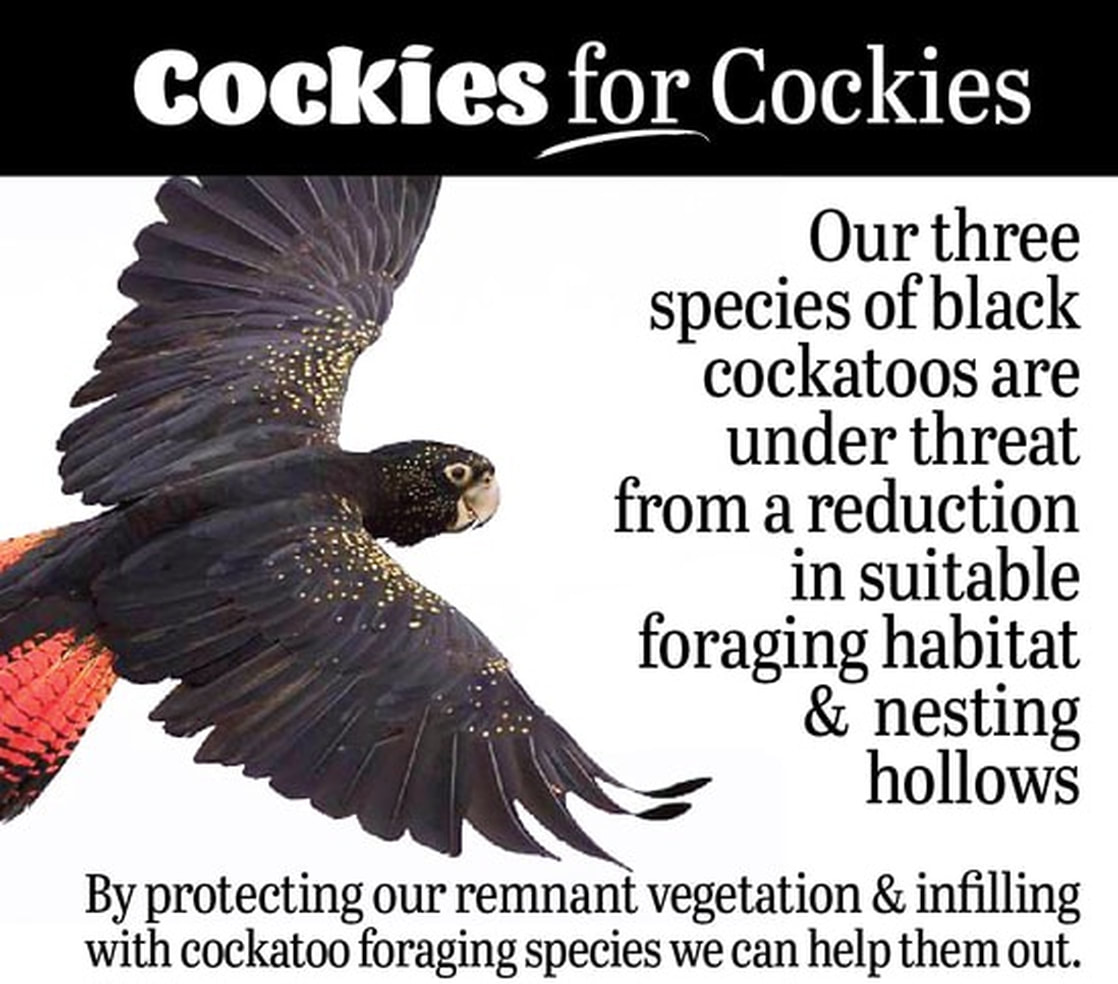
Cockies for Cockies
Protecting our remnant vegetation and infilling with cockatoo food.
​
​
Period: 2024 - 2027 
Funding Body: WICC and State Natural Resource Management
Project Officers: Kylie Cook, Nat Wallen and Tim Gamblin
Picture
Community for Cockies
Black cockatoos in Southwestern WA will be extinct in our lifetime without landscape scale intervention. Using the best available science and scientists, this program will preserve remnant vegetation, revegetate with cockatoo foraging flora and strategically place nesting boxes to provide critical habitat on farms in the Wilson, Owingup and Kent catchment areas. We will also be building the capacity of the next generation of cockatoo custodians by carrying out cockatoo conservation programs and establishing cockatoo sanctuaries in our local primary schools.
Numerous factors have lead to their decline, however habitat loss has had the biggest impact. Land clearing and loss of foraging has caused black cockatoo numbers to decline significantly.
Farmers (aka “Cockies”) in our region have the capacity to reverse this decline. There has been an overwhelming response to our expression of intererest circulated before drafting this application.

Every farm has suitable water sources (dams, soaks and troughs) for cockatoos. Black Cockatoos would benefit greatly from supplementary foraging and in some instances a ‘cockatoo house’ (nesting box) to improve the chances of nesting success . By protecting and improving on-farm remnant vegetation with cockatoo foraging flora and strategically placing nesting boxes we can make a difference.
We will partner with WA’s key authorities in cockatoo conservation to carry out a first class cockatoo conservation program. This program will focus on immediate and long term actions to ensure we deliver lasting results:

Immediate Actions:
• Identify roosts,
• Idenitfy priority locations for revegetation.
• Install nesting boxes,
• Collect seed with Aboriginal Rangers,
• Community revegetation and protect remnant vegetation, • Educational campaign addressing threats, and
• Monitor effectiveness.
​

Long Term:
• Education program in local schools with renowned ornithologist, Simon Cherriman.
​• Seed collection (cockatoo foraging plants) – WICC Revegetation Officer, students
• Students propagate and plant cockatoo foraging sites
• Students observe nesting box installation (which they helped to build)
Picture
Picture
LotteryWest is a supporter of this program
  • Home
  • Get Involved
    • Upcoming Events >
      • The Ripple Effect EOI
      • Soil Testing EOI 2025
      • Dung Beetle Soil Health Initiative EOI/survey
    • Volunteer EOI
    • Membership >
      • WICC Membership Form
      • OKGG Membership Sign-Up
    • Funding Opportunities >
      • Soil Testing
      • Fencing and Revegetation
    • Feral Management
    • Report A Pig
  • About
    • Projects >
      • Current Projects >
        • Soils - New Horizons
        • Climate Smart Agriculture
        • Dung Beetle Soil Health Initiative
        • Wilson Inlet Management Strategy
        • Community for Cockies
        • Cockies for Cockies >
          • Plants Used by Carnaby's Black Cockatoo
        • Saving Boordenitj – Salvaging Bittern Habitat in Southwest WA
        • Healthy Estuaries WA
        • Wilson Inlet Winter Active Dung Beetles: Phase 2
        • Eungedup
      • Previous Projects >
        • Ferals
        • Waste to Net Zero (Biochar Program)
        • OKGG Owingup/Kent Grower Group
        • Soilwise
        • WIGG the Wilson Inlet Grower Group
        • UPtake
    • Our Plans >
      • Lindesay Link Conservation Action Plan
      • WICC Proteacea Vegetation Survey 2016
      • WICC Strategic Plan and Constitution
      • Wilson Inlet Management Strategy
    • Meet the Team!
    • Our Catchment
    • Contact Us
  • WICC News
  • Support Us
    • Kwoorabup Community Nursery >
      • Nursery Volunteer Register
    • Donate
  • Eungedup
    • Eungedup Access Checkout
    • Why Eungedup Wetlands needs to be preserved!
    • How Your Donation will be Use
    • How Eungedup Wetlands will be Managed
    • Our Donors
  • Learning Centre
    • Sustainable Agriculture >
      • Dung Beetle Farm Management Guide
      • Cartoon Collection - Earls Adventures >
        • Managing Water in a Drying Climate
        • Feral Management OKGG
        • Arum Lilies
      • Collection of Dougie the dung beetle cartoons >
        • Rotational Grazing
        • Stock Health
        • Pasture Diversity
        • Soil Chemistry/Nutrient Efficiency
        • Soil Carbon
        • Soil Biology
      • Interviews with local farmers
    • Biodiversity >
      • Interview with Marino Bocuzzi
      • The Abby Carnaby Chronicles
      • Weeds
      • Feral Management
      • Seagrass Report
      • Flora Surveys
      • Interview with Elders >
        • Interview with Elder Vernice Gillies
        • Elder Lynette Knapp
        • Interview with Dr Wayne Webb
        • Interview with Aunty Carol Petterson
        • Interview with Uncle Lester Coyne
        • Interview with Menang Elder Aden Eades
        • Aboriginal Rangers - back on country!
    • Waterways >
      • Wilson Inlet Estuary Sandbar Openings
      • Sub Catchment Reports for Wilson Inlet
    • How to Object to Mineral Titles
    • Our Data
    • Privacy Policy